There is a meeting happening right now, somewhere in a hospital, that will not go well.
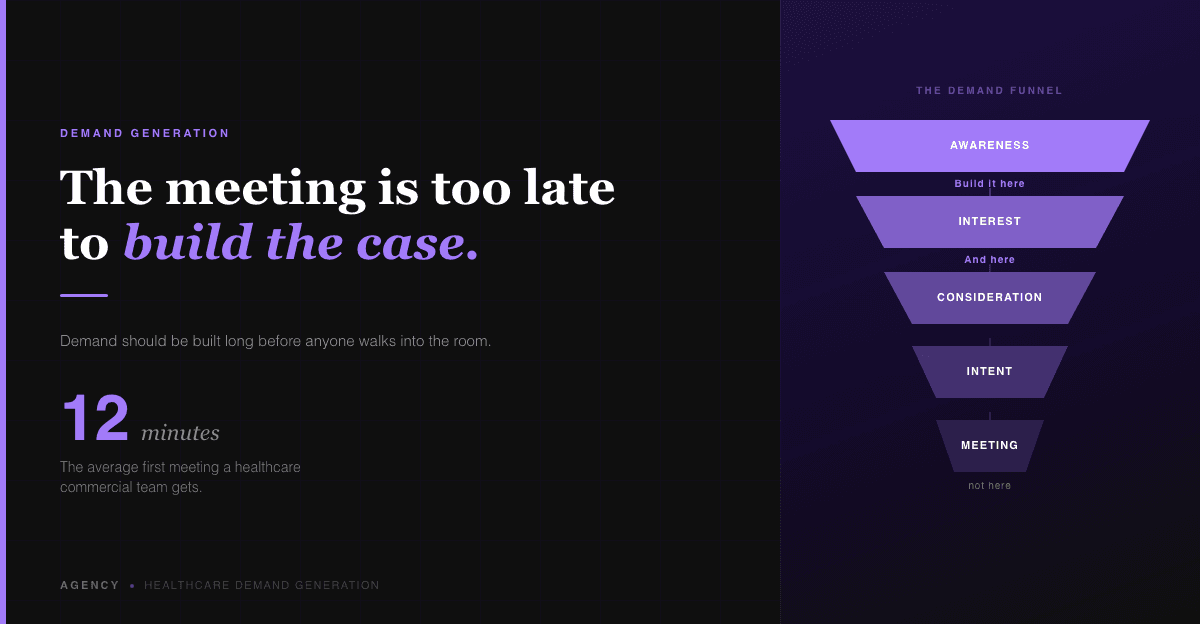
The meeting will not go well because nobody built demand before it started. The rep can be prepared, the product strong, the clinical evidence solid, and the outcome is still the same. Without demand in the room before the rep arrives, the 12 minutes runs out before it begins.
A team spent three years developing a diagnostic device. They ran two randomised controlled trials. They got CE marking, UKCA certification, a Medicare reimbursement code. They hired eight reps, drew up territories, set call targets of 15 per week, built a CRM. They sent the reps in.
Six months later, the pipeline is thin and the numbers are soft. The reps are working hard. Meetings are happening and the product is genuinely good. None of that shows up in the results.
The board is asking why.
The honest answer is that demand was never built. The reps were sent in to do two jobs at once, creating interest in something nobody had heard of and then converting that interest into a purchase decision. In a 12-minute meeting. With a clinician who has three more visits from three other reps booked this week and a ward round starting in twenty minutes.
The Conventional Response
The conventional response to a soft pipeline in healthcare is predictable. And, to be fair, it makes sense on the surface.
You hire more sales people. You train the ones you have better. You tighten territories so each rep is covering fewer accounts with more depth. You invest in better CRM tools so nothing falls through the cracks. You run voice-of-customer research so the reps understand clinical needs more precisely. You build a stronger product story.
These are not stupid ideas. Every one of them has a logic. Better trained reps do perform better, all else being equal. Deeper territories allow more relationship building. Better CRM reduces the chance of a warm lead going cold. Voice-of-customer research produces more relevant conversations.
The appeal of this approach is also straightforward. You can see the activity. You can track it. Call targets, meeting counts, CRM entries, pipeline velocity. Everything is measurable. Everything feels like progress.
And perhaps most importantly, it feels like the problem is solvable by applying more of what you already know how to do. You understand sales. You have a sales function. You can make it bigger, better, more efficient.
This is the logic that has guided medtech commercial strategy for thirty years. It is not wrong exactly. It just addresses the wrong problem.
Why It Does Not Work
The structural issue with the rep-first demand model is not a people problem. It is a context problem.
Healthcare access has changed materially in the last decade. The average UK hospital-based clinician now receives formal sales visits in a more compressed window than at any point since the NHS introduced supplier registration requirements in the early 2000s. Industry data from the ABHI (Association of British HealthTech Industries) suggests that a typical secondary care consultant might receive between 12 and 16 minutes of rep contact time per month across all supplier interactions. The time for any single rep to make their case is, on a good day, 12 minutes. On a bad day, it is a corridor conversation.
That is not enough time to create demand from scratch. It might be enough time to convert demand that already exists. But it is nowhere near enough time to move someone from "never heard of this" to "I want to trial this in my department."
At the same time, procurement decisions in healthcare have moved upward. Where a consultant could historically create a formulary entry or initiate a product trial relatively autonomously, buying decisions now typically involve procurement committees, NICE guidance, value-based procurement frameworks, trust-level formulary reviews. A clinician who loves your product and wants to use it still has to navigate a process that may take 12 to 18 months.
This means the rep is increasingly a converter of demand, not a creator of it. Conversion is where they excel. Navigating procurement, handling objections, managing trials, building relationships with the buying committee, all of that gets done well. What falls short is the demand that should have arrived before the rep did.
But they are being asked to start every conversation from zero, to create interest in something the clinician has never encountered, and to do it in the time it takes to drink a cup of coffee.
It is not that the reps are failing. It is that the system they are operating in requires demand to have been built before they arrive, and nobody built it.
(I have been in rooms where a well-funded team reviewed their pipeline data and concluded the reps needed more training. The reps were excellent. They needed a different brief, not better preparation for the wrong job.)
The other piece of this is what happens inside procurement when a clinician does advocate for a product they have encountered through a rep alone. A product that has been introduced through peer conversations, published in evidence summaries, discussed at a regional conference, reviewed in a departmental meeting, is a different proposition from one a single rep is championing. The former has social proof. The latter has a salesperson's advocacy, which procurement committees are trained to discount.
What Is Actually Happening
There is a useful distinction that most healthcare commercial strategies ignore.
Demand generation and demand conversion are two different activities, requiring two different approaches, two different types of content, and two different relationships with the clinician.
Demand generation is the work of making someone want something they did not previously know they wanted, or recognise that a problem they had accepted as normal is actually solvable. It happens before the buying process starts. It is slow, cumulative, and largely invisible in the CRM.
Demand conversion is the work of moving someone from wanting something to buying it. This is what salespeople are trained for, and what they are good at. It shows up in pipeline, in CRM, in quarterly targets.
The problem in most healthcare commercial strategies is that the same function, the sales team, is being asked to do both. When a rep makes a 12-minute call on a consultant who has never heard of the product, they are attempting demand generation and demand conversion simultaneously. They are trying to create the problem AND present the solution in the same conversation. Sometimes they get lucky. Often the clinician nods politely and the rep marks it as a "warm lead" in the CRM because there was no outright rejection.
Here is the real diagnosis. Demand generation is a separate function from sales. It requires different tools (peer-to-peer conversations, published evidence, educational content, clinical event programming), different timescales (measured in quarters, not weekly call targets), and different success metrics (clinical awareness, peer recommendation, evidence familiarity, rather than pipeline entries).
When a company has no demand generation function, the sales team carries the full weight of both jobs. They carry it imperfectly, because no 12-minute meeting is enough for both.
A Different Approach
If demand generation is distinct from demand conversion, the question is what builds demand in healthcare.
Three levers work. None of them is the direct sales team.
The first is clinical champions. A clinician who has used your device and achieved a good outcome is worth considerably more than a rep's endorsement. Their word travels through peer networks in ways that no amount of sales activity can replicate. A presentation at a regional MDT meeting, a poster at a national conference, a case write-up in a specialty newsletter, a one-to-one conversation between two consultants in a clinical setting. These are demand-generating moments. They happen without a rep in the room. They accumulate credibility at a rate no sales strategy can match.
The investment here is in the relationship with early adopters. Not in getting them to sell for you, but in supporting them to share their experience in the clinical venues they already attend. That means funding conference attendance, helping with abstracts, facilitating peer-to-peer connections, making it easy for them to share what they have learned.
(This is the Equip lever in the three-lever framework. Most companies underinvest here because it does not show up in weekly sales metrics. The returns come later, and they are substantial.)
The second is patient advocacy in patient-facing conditions. This is underused and underestimated. In patient-facing medical conditions, the patient community creates pull demand that the sales team converts. Patients who have had good outcomes want other patients to have good outcomes. Patient forums, patient advocacy groups and specialist patient charities are demand-generating ecosystems where word of treatment options travels fast.
This does not require large marketing spend. It requires a genuine commitment to patient experience, a willingness to engage with patient communities on their terms rather than yours, and real clinical outcomes worth sharing. Where patient advocacy exists around a condition your product addresses, it is arguably the highest-leverage demand lever available.
The third is content-led demand generation. When a clinician has read your white paper, watched a surgical technique video, attended a breakfast symposium, or received a patient outcomes summary before the rep calls, the conversation is different. The rep is not starting from zero. They are deepening an awareness that already exists.
The content does not need to be sophisticated to be effective. A six-minute animated explainer of the mechanism of action. A two-page summary of the phase III data with a clinical interpretation written by a KOL. A webinar with three surgeons discussing their first-year experience. These are not marketing materials in the traditional sense. They are demand-building assets. Their job is to create awareness and interest before the sales conversation begins.
A Case Study
A UK diagnostics company we worked with had developed a workflow automation platform for hospital pathology departments. Their platform reduced manual processing time by around 40%, with strong validation data from two multi-site trials.
They had hired six reps and set 15 visits per week per rep. Pathology labs are understaffed and difficult to access. The reps were getting through the door about half the time and getting meaningful clinical conversations perhaps a third of visits. Pipeline was building slowly. The 12 to 18 month procurement cycle was adding further friction.
The conventional response had already been tried. Better CRM, more targeted prospecting, improved call scripts, a clinical benefits training day. Activity went up. Conversion did not move materially.
The shift they made was structural. They identified eight pathology leads who were current users and had strong results. They supported those leads to present their outcomes at four regional conferences over six months. They funded the development of three short videos, each under ten minutes, featuring one of the lead users walking through the workflow change and the time savings they had seen. They built a one-page outcomes summary featuring the trial data interpreted by one of the KOL users.
The reps' job changed. They were no longer introducing the product. They were following up on a conversation the prospect had already had with a peer, or content they had already encountered. The meeting became a conversion conversation rather than an introduction conversation.
Over the following two quarters, accepted meeting rates went from 29% to 51% of outreach. Average meeting length extended from 11 minutes to 22 minutes. Three of the original champion sites became formal reference sites, visited by 17 prospective clients in the year following. Two of those visits converted to trials.
The reps did not change. The product did not change. The demand environment they were operating in changed.
Practical First Steps
The shift from rep-only demand to a three-lever demand system does not require a restructure. It requires a reallocation of focus.
Start with an honest audit of your current demand levers. Which of the three (clinical champions, patient advocacy, content-led education) are you actively using? Not nominally, but with real investment and intentionality? Most companies find they have some version of clinical champion engagement but no formal programme, some content but little that is genuinely demand-generating rather than sales-support material, and no real engagement with patient communities even where conditions they treat have active advocacy ecosystems.
Then identify your strongest clinical evidence. Not your best slide deck. The actual outcomes your current users have seen. This is the raw material for clinical champion content, patient community engagement, and evidence-based demand assets. If you do not have strong outcome data from current users, that is the first problem to solve.
Find three clinical champions worth investing in. Not the most enthusiastic users, but the ones with credibility in their clinical peer group. The consultant who presents at national meetings. The department lead whose service model other departments look to. The clinical director who sits on relevant guideline committees. Their advocacy is worth more than their clinical preference, because it extends beyond their own practice.
Build one demand asset before the next rep cycle. A case study video, a peer-to-peer outcome summary, a short evidence synthesis for the clinical audience. Something that the clinician can engage with on their own terms, before the rep calls. This does not need to be expensive. It needs to be credible and peer-referenced.
And, importantly, do not give this brief to the sales team. The demand-generation function needs to sit with marketing, clinical affairs, or medical education, wherever the capability to develop clinical relationships and evidence-based content lives. Sales converts demand. It does not build it.
The Real Stakes
There is a version of this conversation that is only about pipeline and revenue, and that version is fine. Commercial sustainability is what funds the next innovation, and no one who has tried to run a healthcare business would argue otherwise.
But there is a more uncomfortable version.
When demand is not built, products that would genuinely improve patient outcomes do not reach the patients who need them. Not because they are not good enough. Not because the clinical evidence is not there. But because a 12-minute meeting was expected to do the work of a six-month demand-building programme, and it could not.
The access problem in healthcare is real. The procurement timeline is real. The clinician time scarcity is real. None of these are things the sales team can solve in a meeting.
Demand is built before the rep arrives. And until it is, the patient outcomes that might have changed will not change.
Michael Colling-Tuck is the founder of AGENCY, a healthcare marketing consultancy that helps MedTech, Pharma, and Diagnostics companies build demand generation systems. He has been involved in 47 product launches across five continents over 20 years. He is the author of It's Not a Sales Problem (Q2 2026).
This is the thinking behind AGENCY’s work on healthcare demand generation.