
Guide · Step 5 of 8 · Growth & paid
Are you buying demand, or amplifying demand you already have signs of?
Paid is the loudest channel in the marketing stack and the one most likely to flatter you. It will spend whatever budget you give it. The question is whether what it’s spending on is real demand the organic and advocate layers have already started producing - or rented attention that will evaporate the day you stop spending.
Inconsistent vs consistent marketing
Paid is the LAST layer. Not the first.
Each layer makes the next one cheaper. Paid only joins the stack once layers 1 and 2 are producing measurable demand that paid can amplify.
The wrong path
Spending paid budget into a vacuum.
Paid is the loudest channel in the stack. It will spend whatever budget you give it, return some metric back, and make the dashboard look busy. That makes it the easiest channel to lean on when leadership asks why pipeline is slow. It is also the channel most likely to flatter the companies least equipped to use it.
Paid does not create demand. It amplifies demand. If your organic content layer is empty, your advocate layer is silent, and your messaging house has not survived an Equipped Test, paid is a megaphone aimed at no audience. Clicks happen. Conversions don’t. The cost-per-meeting climbs each quarter and the response is to spend more.
The honest test is whether you can name the demand signal you’re trying to amplify. “We’re running paid to drive awareness” is not a signal. “Three surgeons in our top fifteen accounts have downloaded the Procedure Pathway Guide and we want to retarget them with the corresponding case study” is a signal. The first rents an audience. The second compounds one.
The right path
Five moves to make paid compound rather than evaporate.
Paid in healthcare is a precision instrument when it’s applied to an existing demand signal. These five moves cover the order-of-operations that decides whether the budget compounds or evaporates.
01
Earn the right to amplify before you amplify
Layer 1 (organic content + messaging house) and Layer 2 (advocate or peer signal) must produce something measurable before paid joins the stack. The Equipped Test from the positioning guide is the cheapest pressure-test for whether you have earned the right.
02
Use paid to amplify a signal, not to manufacture one
The honest job for paid in healthcare is retargeting an audience that organic has already attracted, recovering visitors who came and bounced, and putting weight behind the content asset that is already working. If paid is doing the prospecting, you have the order of operations wrong.
03
Pay for clicks that lead somewhere worth landing
Every paid click should land on a page that earns the next conversation. Generic homepage landings and PDF downloads behind weak forms are paid spend lit on fire. The landing-pages guide covers what good looks like at the click-target end.
04
Measure pipeline contribution, not channel vanity
Click-through rate, cost-per-click, even cost-per-lead are all activity metrics. The honest measure is what proportion of the deals that closed last quarter touched a paid asset on the way through. If the answer is unclear, the attribution model is the bottleneck - fix that before scaling spend.
05
Resist the budget-driven escalation
When pipeline slows, the temptation is always to spend more on paid. The honest fix is almost always upstream - at the messaging, the content, or the advocate layer. Paid is a multiplier. Multiplying zero by a bigger number gives you a bigger zero.
The decision
Are you buying demand, or amplifying it?
The honest answer to this question decides what role paid plays - or whether it should be playing one yet at all. Test your situation against the four cases below.
| If… | Then paid’s job is… | Likely budget shape |
|---|---|---|
| No content engine, no messaging house, no advocate signal | Wait. Paid will multiply zero. | £0 on paid until Layer 1 is live. |
| Content engine producing, but conversion path is weak | Retarget visitors only. Don’t prospect. | Small. £2-5k/mo across retargeting + branded search. |
| Demand forming, conversion path strong, want to scale | Amplify the asset that’s working. Add reach via lookalikes. | Tied to pipeline contribution, not a fixed % of revenue. |
| Patient-facing, B2C funnel, regulated category | Different rules entirely. Read the patient-marketing guide before spending a pound. | Variable. ABPI, MHRA, and platform policy first. |

From the manuscript
The robotics company that stretched the elastic band until it snapped.
A robotic-surgery company had a credible clinical claim about faster patient recovery. The advocate clinicians who used the system were comfortable with the claim because the data backed it within a defined patient cohort. The paid team got hold of it and stretched it.
The ad creative made the claim universal. The landing page softened the qualifying language. The paid funnel scaled fast because the headline was punchy. Within six months, the advocate clinicians who had been quietly carrying the claim for years started distancing themselves from it. One high-profile KOL declined to renew his speaker programme. Two units paused new procedure adoption pending an internal review.
The paid system worked, in the narrow sense that clicks went up and cost-per-lead went down. The commercial system broke, in the wider sense that the advocate layer - the layer paid had been amplifying - withdrew. Campaigns end. Systems compound. Paid had stretched the elastic band of a credible claim until it snapped.
What good actually looks like
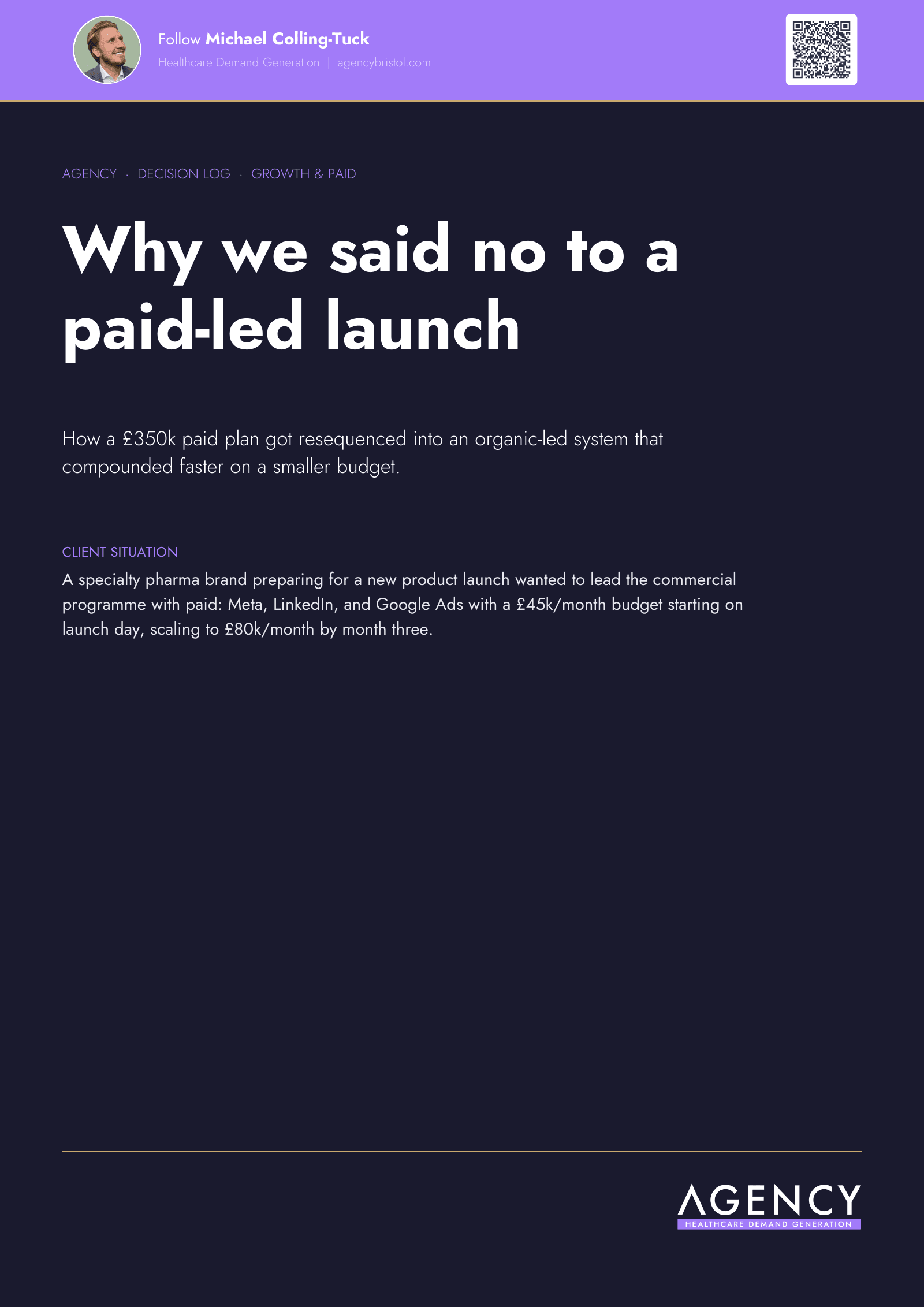
A real channel + SEO + paid programme, sequenced.
The proposal shows what it looks like when paid is layered on top of an existing organic and channel programme rather than fired into a vacuum - including the cadence rules, the attribution model, and the budget sequencing.

Want a sanity check on your paid spend?
Bring last quarter’s paid budget, the conversion path it was pointing at, and the demand signal it was meant to amplify. We’ll tell you whether the budget is amplifying real demand or renting an audience.
Healthcare innovations deserve recognition. We help them get it.