Guide · Step 2 of 8 · Organic social
Founder, team, or brand account?
In healthcare, trust travels through people, not logos. The decision between founder-led, team-led, and brand-led organic social is the one that decides whether a year of content compounds or evaporates. Pick wrong and the content engine runs into the wrong audience entirely.
Four engines. One choice.
Not all four. Pick one. Run it for a year before you add a second.
Founder-led
The named expert
Team-led
The named team
Brand-led
The corporate logo
Community-led
The named members
Where each engine works
- Founder-led: Pre-launch, scale-up, repositioning, founder-led commercial.
- Team-led: Mid-market, distributed expertise, when no single voice is bigger than the company.
- Brand-led: Enterprise pharma, regulated categories where person-led carries personal liability, multi-language EMEA.
- Community-led: Patient advocacy categories, peer-driven adoption, large installed bases.
Where each engine breaks
- Founder-led: Public-company governance, multi-stakeholder boards, founders allergic to camera.
- Team-led: When the team is the founder. When media training is non-existent. When the legal team won't let people post.
- Brand-led: Early-stage, undifferentiated brand, anywhere clinicians are the audience and want to hear from clinicians.
- Community-led: Anywhere there is no actual community yet. Building one is a 2-3 year capital project.
The wrong path
The brand page that’s a brochure with a heartbeat.
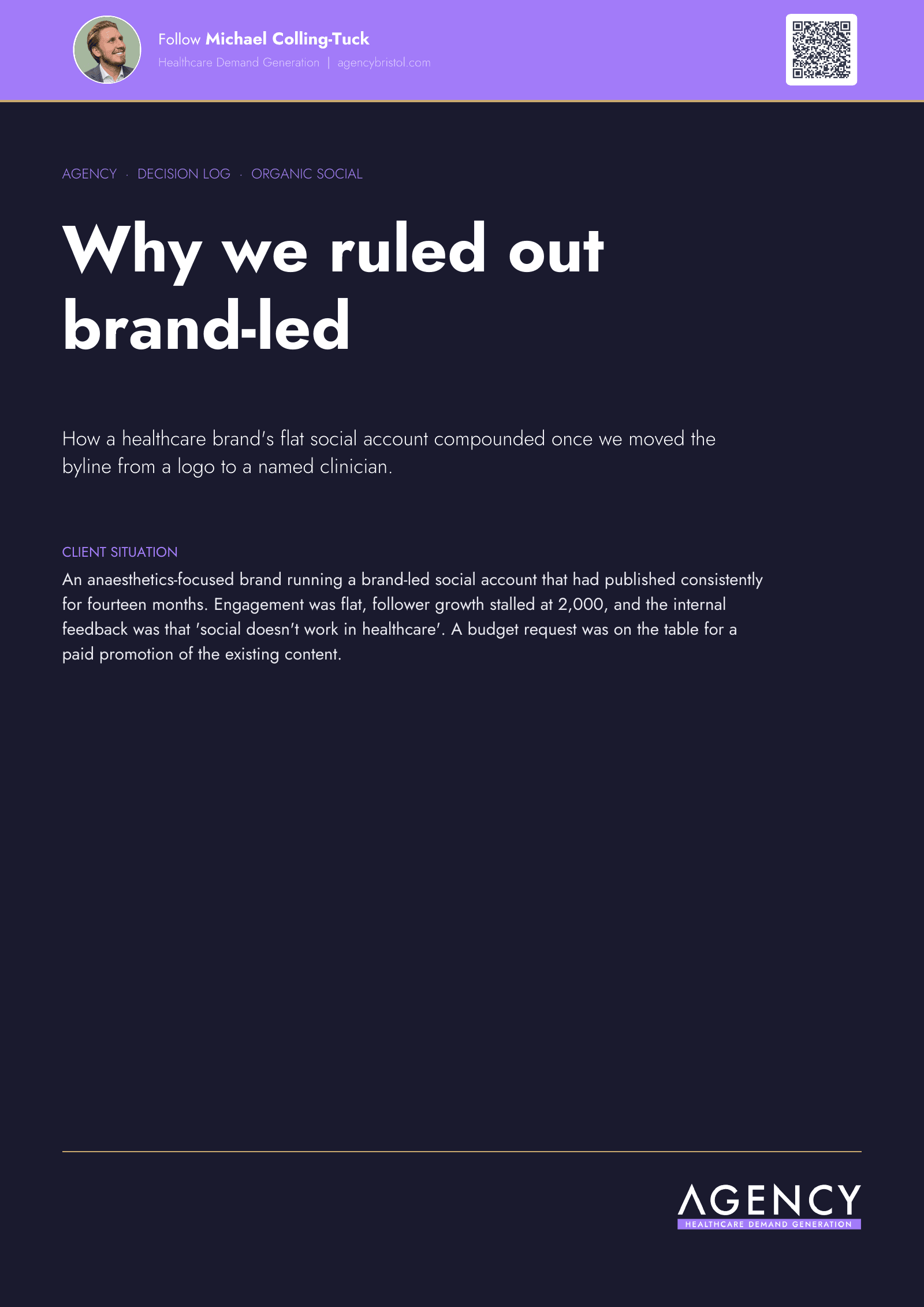
Most healthcare companies default to a brand-led account because it feels safest. Logos, taglines, product news. The content gets written by committee, approved by legal, published into a void. After eighteen months the engagement graph is flat and the conclusion is “social doesn’t work in healthcare.”
Social does work. The brand-led format wasn’t the right fit. In healthcare, trust travels through people. A clinician wants to hear a clinician say something. A founder wants to hear a founder say something. A patient advocate wants to hear another patient advocate say something. A logo telling you about its product is the digital equivalent of a sales rep who hands you a brochure and waits.
The fix is rarely “post more often.” The fix is usually moving the content from a corporate page to one or more named humans inside the company who are willing to put their name on a point of view.
The right path
Five moves to get organic social compounding.
These five moves cover the pre-publication work that decides whether the content engine works at all. The fancier the calendar gets without these, the louder it fails.
01
Pick the engine that matches your stage
Founder-led for early-stage and repositioning. Team-led for mid-market with distributed expertise. Brand-led only when person-led carries personal liability or you're operating across many languages. Community-led only if the community already exists.
02
Cast the people, not the topics
If the engine is team-led, the first move is identifying the three to five people whose voices will carry it. Topics are easy. Voices are scarce. Casting wrong is the most common cause of failure.
03
Build the legal sandbox before you build the calendar
Decide what your named voices can and can't say, in writing, signed off. The legal-comms friction is the rate-limiter on every healthcare social engine. Solve it once and the calendar becomes mechanical.
04
Run for ninety days before you judge it
Healthcare audiences are slow. The signal that an engine is working at day 90 is rarely engagement; it's whether the right kind of person started replying or sliding into DMs. Vanity metrics will lie to you for the first three months.
05
Resist adding a second engine until the first compounds
Adding a brand account on top of a founder account dilutes both. Run one engine for a year. When it's compounding - measurable, predictable, repeatable - then layer the second.
The decision
Founder vs team vs brand - which one fits your situation.
Most healthcare commercial leaders ask this question and quietly hope the answer is “brand” because it avoids the political conversation about whose face goes on the content. Avoid the wishful thinking. Pick the engine that actually fits.
| If you are… | Default engine | The cost of getting it wrong |
|---|---|---|
| Pre-launch or repositioning, founder still close to product | Founder-led | A year of content from a brand account that nobody follows. |
| Mid-market, multiple expert voices, no single dominant figure | Team-led | A founder account that burns out the founder. |
| Public company, regulated category, multi-language EMEA | Brand-led (with named human bylines) | A founder account that exposes the company to liability. |
| Patient advocacy category with an existing peer community | Community-led | A brand account talking at a community that already talks among itself. |

From the manuscript
Four clinicians at dinner. Ninety-second consensus. No rep in the room.
The reality of how clinicians decide what to recommend is uncomfortable for marketing teams who built the strategy on rep access. Eighty-three per cent of HCPs prefer digital channels for product information. Face-to-face meetings have dropped 58% since 2019. Rep access to US physicians fell from nearly 80% in 2008 to 44% by 2016 (ZS Associates AccessMonitor), and the accessible ones give the entire supplier ecosystem about thirty-six minutes a week.
The decisions still get made - they just get made through peer voice instead of through reps. A surgeon catching up with three colleagues at a conference dinner reaches consensus on a product in ninety seconds. The voice that shapes that consensus is a clinician they already trust, not a brand they already filtered out.
Organic social, run on the right engine, is the digital version of that dinner table. A founder or named clinician posting a real point of view becomes the source the audience quotes. A brand account posting product news becomes the source the audience scrolls past.
What good actually looks like
Two artefacts: the toolkit we built, and the thinking behind it.
The toolkit shows the actual scope, format mix, cadence and governance of a real social and email programme delivered for a healthcare client. The decision log shows the engine choice we recommended and the engine we ruled out.
Want a second pair of eyes on your engine choice?
Bring the people you have, the legal sandbox you operate in, and the audience you need to reach. We’ll tell you in a 60-minute triage call which engine actually fits - and which one would burn the year.
Healthcare innovations deserve recognition. We help them get it.