
The clinic was in a football stadium, and the equipment lived in flight cases.
I should explain. Some years ago I co-founded a pop-up orthopaedic clinic with two surgeons. We took the vacant executive boxes at Ashton Gate in Bristol and turned them into consulting rooms. On Saturdays, Bristol City played football. On Tuesdays, we ran consultations, wrote care plans and injected knees.
I was the marketing director, and I had a vision. A luxury healthcare experience. Concierge service, coffee brought to the patients, amazing parking, a beautiful setting. We spent months on the concierge experience. (Months.)
One day I went to check on the patient experience, and a lady was sitting there crying.
She did not care about the executive box, or about anything else I had arranged for her. All she wanted to know was what was going to happen to her.
So that was the concierge budget well spent.
Think about what she had done. She had booked and she had turned up. On paper she is the best result a campaign can produce. And there she was, frightened, with a question nobody had answered.
She came anyway. Every clinic also has the others, the ones who fill in the same form, book the same sort of slot, carry the same question around for a few weeks and then do not come.
On an enquiry report, she and they are the same row.
Forty-two metrics and a silence
A different room. A pharmaceutical marketing team had built a dashboard with forty-two metrics on it. Impressions, reach, click-through rates, download counts, cost per click. I sat in the quarterly review where the marketing leader presented it. It was beautifully designed and colour coded, and most of it was trending in the right direction.
The CFO listened politely for about five minutes, then asked a question.
"How many of these leads became customers?"
Silence.
Not because the answer was bad, but because nobody knew it. The dashboard tracked everything that happened before the sale and nothing that connected to the sale itself.
Patient marketing has its own version of that question, and it is shorter. How many of them came in?
The enquiry report is usually a lovely thing. Form fills by week, by source, by landing page, and somebody has added a trend arrow. It still cannot tell you, because attendance was never a column in it. In the book I say engagement without conversion is entertainment. An enquiry without an appointment is not far off.
In budget season that matters more than usual. Sooner or later somebody in the room asks whether the patient-demand line filled any chairs, and it is a better meeting if you asked first.
Why everyone counts the form
I do not think this is laziness, and I say that as a man who spent months on a concierge.
A form fill is clean. It is one event with a timestamp, a source and a campaign attached, and it arrives the same day the money is spent. It drops into a weekly report and a monthly invoice without anybody having to ring anybody.
It is also yours. The form sits on your landing page, under your tracking. Everything after it lives somewhere else. The callback happens in a clinic's office, the booking sits in a clinic's diary, and attendance is recorded in a system marketing has never had a login for. (At the stadium I was, for once, on the clinic's side of that line.)
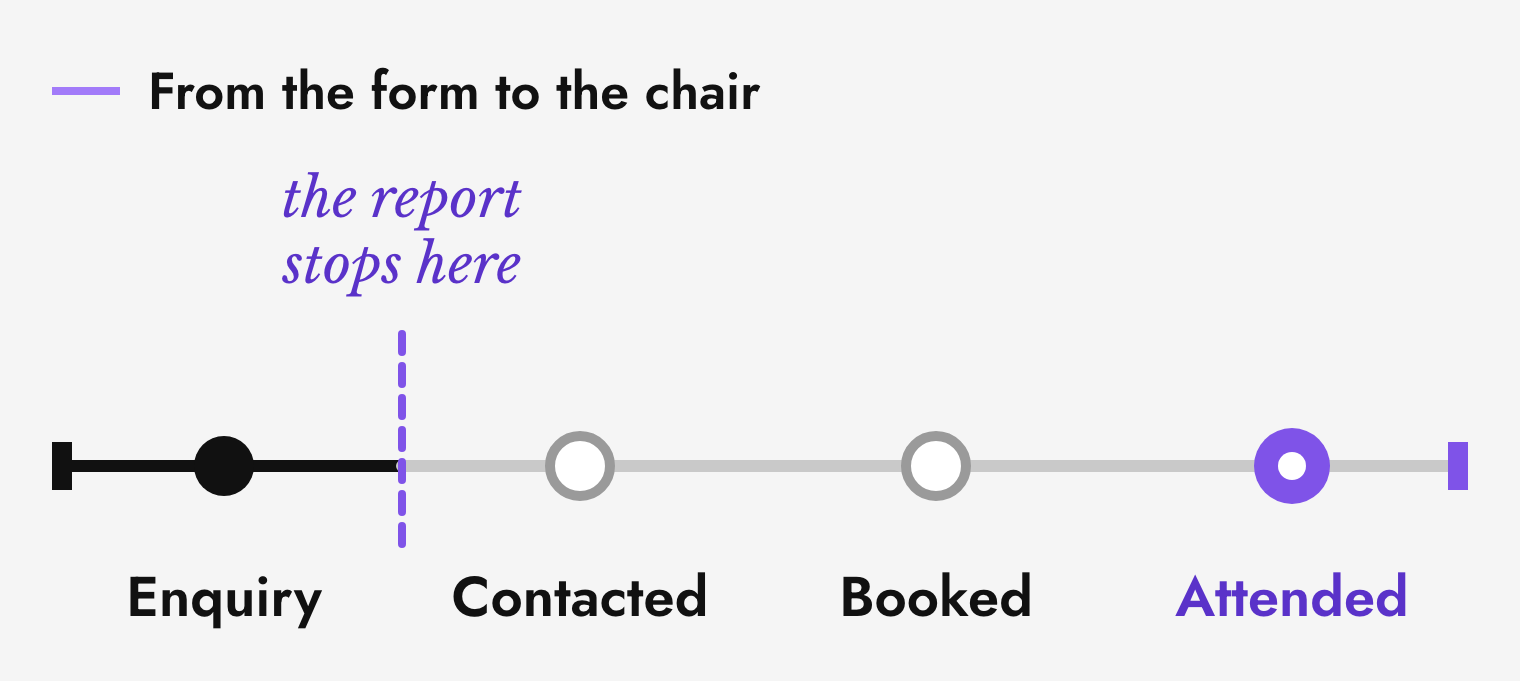
Then there is the data question, which is a fair one. Patient information is sensitive, the clinic owns the relationship, and nobody in marketing wants to be the person who asked for names they should not have. So the report stops at the boundary, and everyone quietly agrees that the boundary is where the job ends.
The platforms help it along. They are very good at reporting the leads they can see, and they have nothing to say about what happens next.
All of it is reasonable. It is what you get from sensible people working inside a system that was never built to follow one patient all the way through.
The bit of the road nobody owns
Say a woman fills in a form one evening, after putting it off for a while. The form lands in an inbox at the clinic. The callback takes a few days and goes to voicemail. When they do speak, the first slot is weeks away.
Weeks is a long time to stay brave.
I know a little about what happens in those weeks, because a professor once explained it to me. I had bumped into him on a call about robotics, of all things. He was from Bath University, and when I asked what he did he said, "I am an expert in communicating with people in pain."
I told him I was running direct-to-patient campaigns and asked if he would look at some of our materials. He did, and he said something I have never forgotten.
"I do not know who you are talking to here, but it is not patients. They do not want to know about the product. All they want to know is what is going to happen to them."
(If that sounds familiar, yes. I was told by a professor, and then again by a lady in an executive box. I got there in the end.)
He walked me through the cycle a patient goes round. Is it going to make the pain stop? It is not going to make it worse, is it? What are we going to have to do to make this happen? How much pain afterwards? What effects on my family, my job, my life? And then, often, they go back round to maybe I am just getting older. Maybe I will put it off.
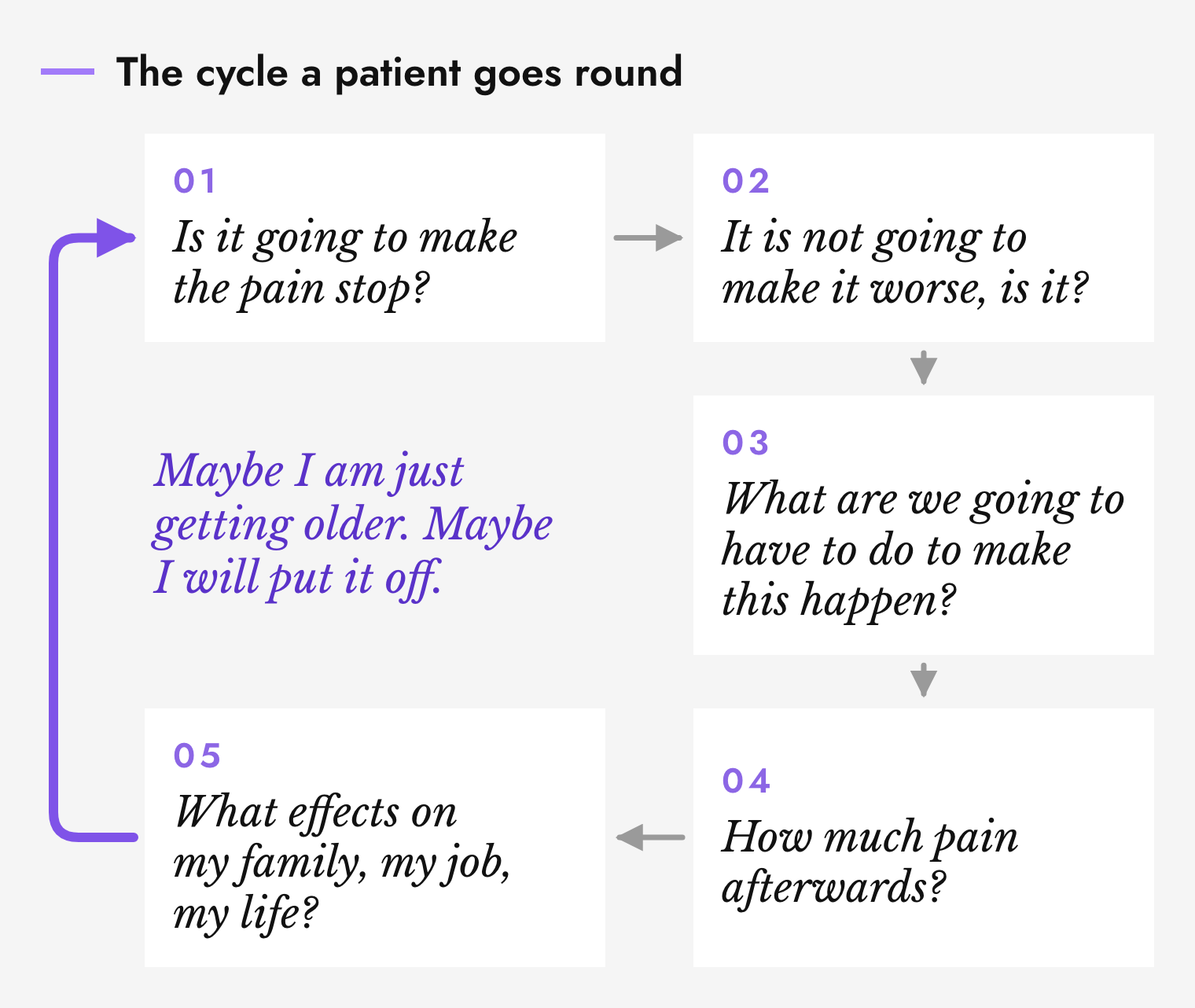
Pain comes and goes. When it is bad, people look for options. When it eases, they leave the options alone and tell themselves things are okay.
Now put that next to a long wait with nothing in it. The form was filled in on a bad day. The appointment falls on a better one. Nobody has told her what will happen on the day or how to move the date, so she does the easy thing and stays at home.
In the campaign numbers she is a success, from the right source at a respectable cost. In the clinic diary she is a gap. Those two records never meet, so nobody learns anything from her.
It gets worse when the money moves. A campaign that brings in a lot of cheap, curious enquiries looks brilliant when all you count is forms. A campaign that brings in fewer, more serious ones looks expensive. If nobody counts attendance, the budget follows the first one every quarter and the waiting room gets no fuller.
The dashboard that said it was failing
The same blindness cuts the other way.
On one of our direct-to-patient programmes in Europe, we ran search advertising for patients actively looking and social advertising to reach people earlier in their journey, and tested regionally before scaling. Healthcare advertising is difficult to measure, because conversion tracking is restricted and plenty of visitors reject cookies. On the platform dashboards the results looked thin, and anyone reading only those dashboards could easily have pulled the budget.
We had built server-level backend tracking as the single source of truth, so we were not relying on the platforms. The results were there. Without it, the easy decision would have been the wrong one.
So a count that stops at the form will flatter a campaign that fills nobody's diary, and a platform that cannot see past a cookie banner will condemn one that does. Either way the decision is being made at the wrong end of the road.
Start at the chair
Work backwards from the outcome that matters. For patient demand that outcome is the attended appointment. The click and the form are only interesting if they lead there.
None of what follows needs a new platform.
One record per enquiry comes first. Source, enquiry date, contacted, booked, attended, no-show, rearranged. The same record travels from the form to the chair, whoever touches it next. We are building exactly this with a client at the moment, and the pre-appointment emails sit between booked and attended.
Then agree the handoff before the campaign goes live. Who calls back, how quickly, and where the result gets written down. That is a conversation with the clinic and no tracking setting will have it for you. It is far easier before the enquiries arrive than after.
Then answer the fear before the day, which is the lady in the executive box again. Those emails are where her question gets answered while she is still at home. They go out from the clinic, in the clinic's name. A confirmation when she books, saying plainly what happens next. A short note a week before, covering what happens on the day, what to bring and where to park. A reminder two days before, with one simple way to rearrange instead of vanishing. None of it is promotional and none of it needs a product claim. It goes through review like everything else, and in my experience it is some of the easiest copy to get approved.
Measure on your own side of the cookie banner, with tracking that records what happened and not what a platform was allowed to see.
And report counts, not names. Most of the time you do not need to know who the patients are. You need to know how many came from each source, month by month, agreed with the clinic and inside the data protection rules.
What to take into the budget meeting
You can start this week without asking anyone for money.
Pick one campaign and last quarter's enquiries from it. Ask the clinic how many of those people attended. If nobody can tell you, count by hand for one month. It is tedious, and it may well be the most useful thing you do this quarter.
Then find the biggest drop. It will be between enquiry and contact, between contact and booking, or between booking and attendance. Wherever it is, that is your first fix, and it often is not a marketing fix at all. It is a callback rota, or an email nobody sent.
When the meeting comes, change the order of the slide. Attended appointments at the top. Cost per attended appointment next. Enquiries underneath, as the explanation and not the headline.
Somebody will ask how many of them came in. It is a far more comfortable moment when the answer is the first line on the slide.
We have put the record, the three emails and the budget slide into a short guide.
Or request a free 60-minute call. I review every request myself before a call is confirmed.
Every form fill on that report was somebody who worked up the nerve to ask. Some of them got a callback and a date. Some got voicemail and a long silence, and went back to living with whatever made them ask in the first place.
The lady at Ashton Gate did not need a concierge. She needed someone to tell her what was going to happen. She at least made it to the chair, where I could see her.
Your enquiry report has people in it who never got that far, and it is counting every one of them as a win.
References
- Colling-Tuck, M. (2026). It's Not a Sales Problem. Chapter 12, Patient Marketing (Stadium Clinic at Ashton Gate, the Bath professor and the patient concern cycle, backend tracking); Chapter 17, Measurement That Matters (the forty-two metric dashboard, the CFO's question, working backwards from the outcome). https://agencymedicalmarketing.com/book
This is the thinking behind AGENCY’s work on patient marketing for medical devices.
Where to go next
Four useful places to continue.
Target, play, read or listen.
01 | TargetNHS Trust IntelligenceFind the NHS trusts that need what you sell.trusts.agencymedicalmarketing.com
02 | PlaySnake Oil and LaddersThe healthcare marketing compliance game.Free to play online.
03 | ReadIt's Not a Sales ProblemThe book the method comes from.agencymedicalmarketing.com/book
04 | ListenThe PodcastHealthcare commercial strategy, discussed.agencymedicalmarketing.com/podcast