
The best sales lesson I ever had took five words, and none of them were mine.
Early in my career I was selling aesthetic equipment into clinics. Capital kit. The sort of purchase everybody in the building has to agree to.
I had done everything right. The clinical team loved it. The practice manager had signed off the money. I was, as far as I could tell, about to close. (I was young. A signed budget felt like the finish line.)
Then someone raised their hand.
"You have forgotten about me."
The IT manager. He wanted to talk about interoperability. How would this thing plug into the systems the clinic already ran? And I had nothing, because until that second I had not known he was a stakeholder. I am not sure I had known clinics had one.
He pulled the whole deal down. Five words and a question about connectors.
I would love to tell you I learned the lesson that afternoon. I learned it years later, which is the usual timetable. I had walked in with my story and told it well. I had never once asked what questions were already in the room before I got there.
He had one. It was a good one. And it was never going to be in my pitch, because my pitch was about me.
That is the mistake I now find on nearly every healthcare website I read, and, as you will see further down, on our own.
For twenty years there was a person between the company and the buyer who could hear the real question underneath the polite one. That person is in the room far less often now. The page is the rep, and the page cannot see the hand go up.
When I carried the bag, the brochure said one thing and the surgeon asked another, and my job was to notice the gap and answer the second thing. A good rep can hear "will this make my life harder" sitting underneath "what is the tip diameter" and answer the first. Nobody wrote that down anywhere. It was the job.
In 2008 nearly 80% of US physicians met with most pharma reps. By 2016 it was 44%. The buyer has not changed. They still arrive with a question. What has changed is that they increasingly meet you in writing first, on their own, probably in the evening, with nobody beside them to translate.
A rep cannot stand next to your website. So the page has to do what the rep did, and most pages were never built to.
In the book I say messaging climbs three steps. Broadcast: "our product can help you." Problem Solving: "we solve this better than the alternatives." Customer Centric: "we make your day better." Most healthcare pages never leave the first step. Specifications, company history, the year you were founded. Nobody asked, but the slide is in the deck, so we present it.
I understand why. Features are facts, and facts are safe. They have been through review, nobody in legal loses sleep over them, and they leave the reader to do all the work of deciding why they matter. Late in the evening, with a board pack open in another tab, very few people are in the mood for homework.
The procurement lead who turned to the back page
Also early in my career, I watched a procurement lead pick up our white paper, flip straight to the back page to see who had funded it, see our logo, and close the document.
Meeting over.
It took her roughly the time it takes to turn to the back of a document, and I learned something that day that took years to fully understand. (There is a pattern forming here, and it is not flattering.)
Every decision-maker in the NHS has been trained to hunt for bias and exclude it. That is not cynicism. It is professional competence, because the money is public, the stakes are patients, and the accountability is personal. She was doing her job, and doing it well.
She had arrived with a question too. Hers was "can I trust this?" and the document answered "here is our evidence" with our logo on it.
The IT manager's question was "will it connect to what I already have?" and I had answered "look how much the clinicians love it."
Two buyers. Two questions. Both times I answered a different one. Both times I thought I had done rather well, right up until the moment I had not.
Five reps, five companies
The first time I built a messaging house was for a surgical robotics company whose sales team had been winging it for two years. Every rep had their own version of what the product did and why it mattered. I put all five versions side by side, and the only thing they agreed on was the product name.
Nobody was doing anything wrong, exactly. Each rep had filled the vacuum with their own reading, and each version worked for whoever wrote it. The market, meanwhile, was hearing five different companies, and wondering which one to call.
So we built the house. A roof, which is the core promise, specific enough that a customer would actually say it matters to them. "Delivering diagnostic clarity in minutes, not hours" is a roof. "Better healthcare for everyone" is a slogan. Three pillars underneath, what it does, how it makes the user feel, and why the claims are credible. Then the foundation, which is the evidence, and which is usually the one part a healthcare company is already good at.
The emotional pillar is the one I always have to fight to get into the document. Somebody usually wants it out, on the grounds that surgeons do not have feelings. They do. A surgeon choosing an implant is choosing something that will have their name on it for years, and they know it better than we do.
Here is the bit the book admits and most consultants would rather not. I handed the full messaging house to a sales team, and they ignored it completely.
It was too much. What a rep needs is the top three to five messages for each person they actually meet, pulled out of the house, short enough to say without a slide. The house is for marketing. The reps need the extract. I learned that by watching the whole thing gather dust, which is a more expensive way to learn it than reading this paragraph.
And from one house you get different first lines for different people. For the surgeon, the precision and the revisions. For the finance director, the savings and the payback. For procurement, the track record and the support. Same product, same evidence, a different opening sentence depending on who is reading, and that is the whole trick.
The IT manager would have had a first line too, if anyone had thought to write one.
Four questions, none of them about a product

When you stop asking "what do we want to say" and start asking "what is she already wondering", the questions turn out to be few, and plain, and rarely about you.
Here are four we think commercial leads in healthcare arrive with, which is why four of our own service pages now open on them.
The forecast is approved. Will the market follow it?
Your best rep knows it. Does anyone else?
The seats were filled. By whom?
The market looks promising. How will you enter it?
Not one of them mentions a product. Each is about the reader's own exposure. The number she has to defend in March. The know-how that leaves the building with her best rep. The congress that photographed beautifully and filled a spreadsheet with badge scans. The distributor conversation that is quietly becoming the strategy.
The first line of a page is either an answer or an advert. There is no third option, however nicely it is designed.
The bit where I read our own site
It would be rich to write all of this without the obvious confession, so here it is.
A few weeks ago I read our own website as if I had never heard of us. Too many of our service pages opened on us. What we do, how we do it, the frameworks with our names on. All of it accurate. Almost none of it opened on the question a buyer would actually arrive carrying.
The idea of running your own agency is that you finally get to do things properly. No head office brand guidelines, no committee, nobody else to blame. The reality is that every good hour goes to client work and your own shop window is the last thing anyone looks at, including the person whose name is over the door. When you run the place there is nobody whose job it is to tell you. You have to go looking, and it costs a bit of pride.
So four of our service pages now open on the four questions above. The rest are a work in progress, a few others have followed, and I suspect that is permanent.
What to do before Friday
None of this needs a new website or a brief. The first pass needs about an hour and a bit of nerve, and you can do it this week.
Find the question first. Your sales team already hears it. It is the thing asked in the first five minutes of a good meeting, the line in an inbound email that makes you sit up, the moment a clinician leans forward in a corridor or over coffee after a case and says "that is exactly the problem." Collect a dozen of those, in the buyer's own words, before anyone writes a headline. Not a paraphrase that has been through three rounds of internal polish. If a commercial director says "will the market follow it", that is the line, full stop.
Then put it at the top, and answer it before you introduce yourself. The company history can wait. So can the awards. One or two sentences that speak to the reader's exposure, then the evidence underneath. We build proposals the same way, outcomes first and credentials last, because a good proposal is about the hospital, not about you.
Give each stakeholder their own first line. The IT manager had a question. So did the procurement lead. One page that tries to answer everyone usually answers nobody, which is why one page per buyer question tends to beat one page per product. Before you write, list everyone who can stop the sale: the lead clinician, the ward manager, procurement, finance and, depending on the product, IT, infection control or quality assurance. I can tell you from experience that IT is a bad one to find out about at the end. Then write each of them a first line.
Then stress test it, with the four questions I ask at the end of every messaging workshop, with the draft positioning up on the wall. Is it credible and supportable with evidence? Is it meaningful to the customer? Is it difficult for a competitor to claim? Can the whole organisation understand it and say it in one sentence without reading it? The first one kills most drafts. Then you ask the room to say the positioning out loud, and you find out about the fourth.
And the compliance point, because somebody always raises it, usually with some relief. A well-framed question makes no product claim of its own, and "will the market follow your forecast?" promises nothing about a device. A leading question can imply one, so the question goes through review with its answer, like everything else. The claims sit underneath the answer, where they have always belonged. The question goes in front.
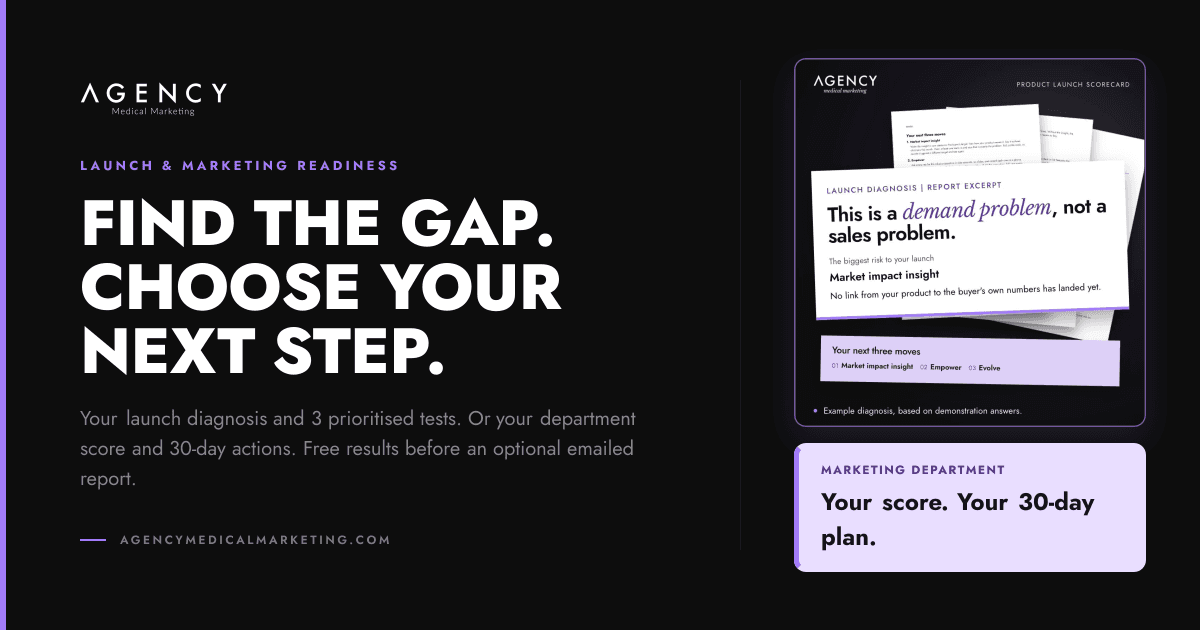
We have put the method, the diagnostic and the stress test in a short guide.
Try it tonight. Open the three pages your buyers visit most. Read only the first two sentences of each and ask, plainly, whose question does this answer? If the honest reply is "ours", that is where you start.
Then ask your newest rep to explain your positioning in one sentence without looking at anything. Whatever they say is what the market is hearing.
I lost a deal I thought I had won because I never asked what question was in the room. He had to raise his hand to tell me, and he was kind enough to do it in five words.
Your website is losing deals the same way, in its first ten words, and nobody is raising a hand.
References
- Colling-Tuck, M. (2026). It's Not a Sales Problem. Chapter 8, Empower Your Sales Team (the IT manager, the decision-making web, proposals, field intelligence); Chapter 9, Building Your Messaging Architecture (the messaging house, the three levels, the stress test); Chapter 12, Patient Marketing (the procurement lead and the white paper). https://agencymedicalmarketing.com/book
- ZS. (2016). As doctors keep closing doors on pharma reps, do digital communications provide a better solution? Press release, 24 August 2016. https://www.prnewswire.com/news-releases/as-doctors-keep-closing-doors-on-pharma-reps-do-digital-communications-provide-a-better-solution-300317132.html
This is the thinking behind AGENCY’s work on sales enablement for healthcare teams.
Where to go next
Four useful places to continue.
Target, play, read or listen.
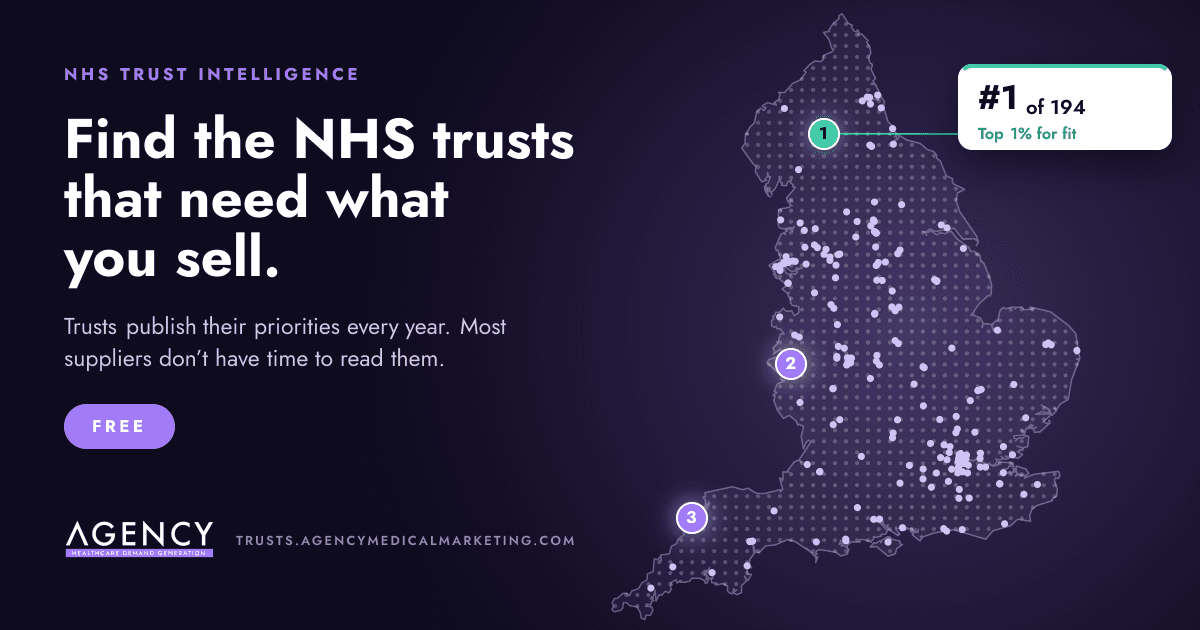
01 | TargetNHS Trust IntelligenceFind the NHS trusts that need what you sell.trusts.agencymedicalmarketing.com
02 | PlaySnake Oil and LaddersThe healthcare marketing compliance game.Free to play online.
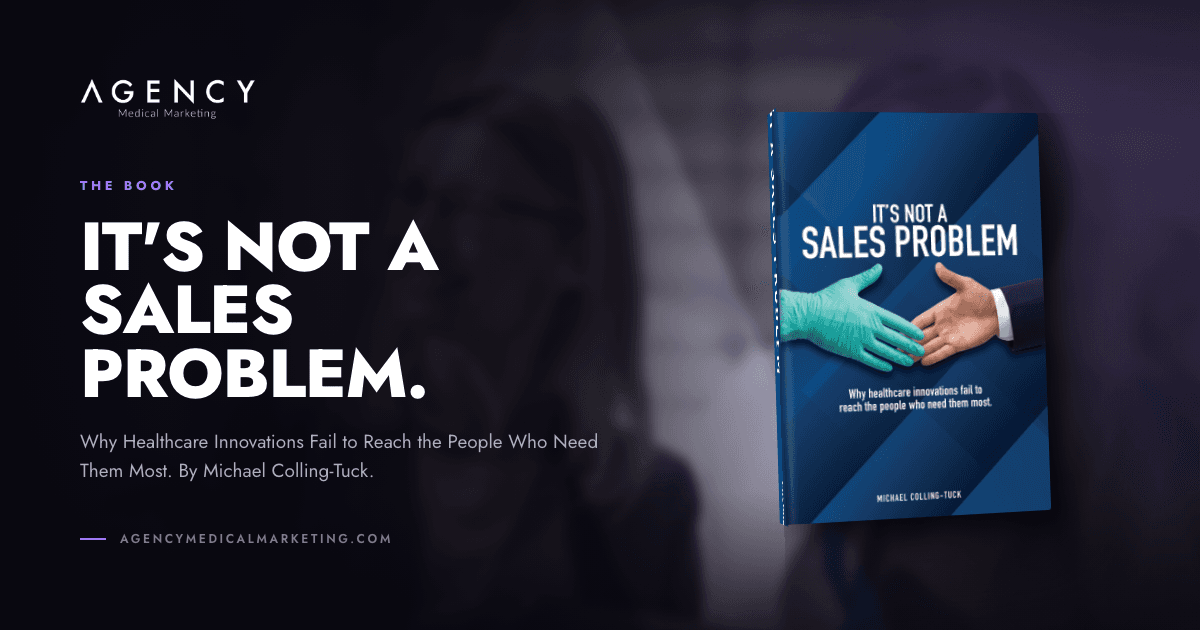
03 | ReadIt's Not a Sales ProblemThe book the method comes from.agencymedicalmarketing.com/book
04 | ListenThe PodcastHealthcare commercial strategy, discussed.agencymedicalmarketing.com/podcast