
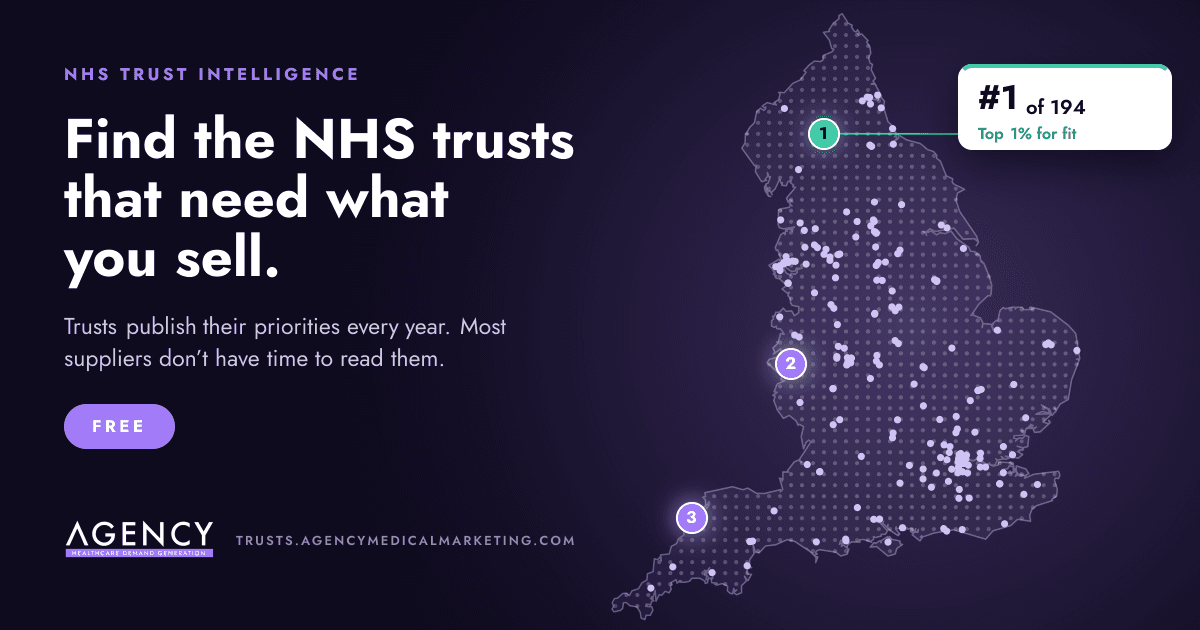
NHS account intelligence
NHS Trust Intelligence
See which NHS trusts fit your product, using their stated priorities and the evidence behind each match.
Explore NHS Trust IntelligenceFree guide · Product launches
The seven-figure launch that lands with a thud is rarely a product problem and rarely a sales problem. It is a skipped-stages problem. The five stages, the team audit to find your gap, and the system that replaces launch-day hope. Eight minutes to read.
Read it all below, free. Or take the PDF with you →
That number has a comfortable interpretation and an uncomfortable one. The comfortable one: launching is hard, most people miss, a miss is survivable. The uncomfortable one: the failure rate is not inevitable. It is the predictable outcome of launching without a system.
First, be honest about what counts as a launch. A new product is a launch. So is a proven product entering a new territory, a new country, a new distribution partner, a new sales team. In our view anything under three years old is still launching, whether or not the launch party has been and gone.
Second, be honest about the market the launch plan assumes. In 2008 reps could reach nearly 80% of their target list; by 2016 it was 44% (ZS Associates AccessMonitor, US physicians). Our own arithmetic on what remains: around twelve minutes per supplier interaction, perhaps three slots a week. Call it thirty-six minutes, for every supplier combined. The launch model most plans still assume, reps building demand one meeting at a time, ran out of meetings years ago.
Launches do not fail at launch. They fail earlier, quietly, at one of five stages, and each skipped stage compromises everything after it. The stages are boring, unglamorous, and they cannot be skipped. Every stage you skip is a stage your competitor will not.
01
Not to sell to them. To design with them. Clinicians who help shape the problem definition become the early adopters, the reference sites, and the conference voices later. This is not manipulation, it is collaboration, and skipping it means launching to strangers.
02
Real means someone is measured on it, budgeted for it, or losing sleep over it. A clinical improvement nobody is accountable for is a feature in search of a problem. Validation is conversations and evidence, not conviction in a board deck.
03
The unit of product-market fit is the market impact insight: the sentence that connects your product to a number the buyer is already measured against. Healthcare does not do transformation. It does incremental improvement. Your product needs to replace a step in the existing patient care pathway, not redesign the pathway.
04
Our bar: if the sales team cannot deliver the value proposition in sixty seconds, compellingly, consistently, without reading from a slide, the launch is not ready. Messaging tested on real buyers, rehearsed until it sounds unrehearsed.
05
Feasibility is not a section of a proposal. It is a capability you build before you launch: implementation plans, training, service response, the answers procurement will ask for in writing. The first tender is a bad place to discover you do not have them.
When the number is missed, the reflex is to fix sales: more reps, more training, a new CRM. Sometimes that is right. Usually it is not, and the distinction takes one honest look.
Sales problem
Demand problem
Getting meetings but not closing
Not getting meetings at all
Buyers know who you are but are not buying
Buyers have never heard of you
Objection handling needs work
No opportunity to handle objections
Fix: better training, materials, process
Fix: build awareness before the call
Treating a demand problem with sales solutions burns budget and demoralises the team: it asks reps to do two jobs, create demand and close it, in a market that gives them thirty-six minutes a week to do either.
Run this with your commercial team in a Monday meeting, not alone at a desk. Score each statement 1 (strongly disagree) to 5 (strongly agree), total each section out of 25, and argue about the scores: the argument is the point. The three sections are the 3 Es, audited in the canonical order, because you cannot evolve your channels if your foundation is not solid, and you cannot equip advocates if you have not given them something worth advocating for.
Give the commercial operation the intelligence, the messaging architecture, the tools and the evidence base to compete before anyone enters a room.
Our reps have materials they actually use in customer conversations.
1 · 2 · 3 · 4 · 5
Our pitch tells the buyer's problem story, not our feature list.
1 · 2 · 3 · 4 · 5
Any rep can deliver the value proposition in sixty seconds without a slide.
1 · 2 · 3 · 4 · 5
Our materials work for procurement and finance, not just clinical champions.
1 · 2 · 3 · 4 · 5
A new rep can get up to speed in weeks, not months.
1 · 2 · 3 · 4 · 5
Section total
/ 25
Move from product-led selling to problem-led engagement, with a digital presence that reaches clinicians the sales team will never meet and works when nobody is present.
A clinician who searches our product category finds us on the first page.
1 · 2 · 3 · 4 · 5
Our website explains the problem we solve, not just what we sell.
1 · 2 · 3 · 4 · 5
We publish content clinicians find genuinely useful, not just promotional.
1 · 2 · 3 · 4 · 5
Prospects mention seeing our content before we ever contact them.
1 · 2 · 3 · 4 · 5
Our digital presence generates enquiries while the sales team sleeps.
1 · 2 · 3 · 4 · 5
Section total
/ 25
Give the people around you what they need to carry the message, so credibility operates independently of the sales team.
Satisfied customers actively refer and recommend us unprompted.
1 · 2 · 3 · 4 · 5
We have reference sites that procurement teams can call.
1 · 2 · 3 · 4 · 5
Our advocates have the data and talking points to make the case accurately.
1 · 2 · 3 · 4 · 5
Customers have presented our outcomes at conferences.
1 · 2 · 3 · 4 · 5
Respected voices in our specialty mention us positively to their peers.
1 · 2 · 3 · 4 · 5
Section total
/ 25
Are your reps getting in the room?
Yes, but not closing: likely a sales problem. Blocked at the door: likely a demand problem.
When you do get a meeting, does the buyer already know who you are?
Yes: demand is working. No, you start from zero every time: demand problem.
Could you turn marketing off tomorrow and nothing would change?
No, we would lose pipeline: marketing contributes. Yes: you have a brochure department, not marketing.
Lowest section score is where to start. Fix one E, then move to the next: the Es are taught in sequence for clarity, but in a running commercial operation they work simultaneously.
The other reader of this guide does not have a launch. They have a flagship: a proven product whose line has gone flat while the market moved. The same five stages apply, run as revitalisation. Bring current users back in at the concept stage and find out what changed. Revalidate the problem, because the person measured on it in 2021 may not be measured on it now. Reforge the market impact insight against today's targets. Re-test the pitch nobody has touched in three years. Re-prove feasibility against this year's procurement questions.
The reason to run it now rather than after the next quarter's numbers. Our view: by the time the numbers tell you there is a problem, the competitor's system has been running for eighteen months.
A launch that works is not a date. It is a loop, and each part feeds the next:
Once the loop runs, demand stops being something you chase around launch day and becomes something the system generates.
“Every stage you skip is a stage your competitor will not.”
Take it with you
Everything on this page, designed for print, with the three score sheets as ready-to-run pages for your next commercial meeting.
No email, no form. It is yours to keep, print and forward to whoever needs it.
Download Why Launches MissThree ways forward, in ascending order of commitment.
The Product Launch Readiness assessment scores the same launch from a different angle: 15 questions across regulatory, commercial, events, financial and brand readiness, a 0 to 100 score, and your weakest areas named.
Take the 30-minute audit in this guide into your next commercial meeting. The PDF version prints the score sheets ready to hand out.
A free hour with Michael against your own launch numbers. No pitch: if we can help, we will say how, and if we cannot, we will say so.
Healthcare innovations deserve recognition. We help them get it.
Find the right NHS accounts, assess your readiness, explore campaign decisions or read the thinking behind our work.
See which NHS trusts fit your product, using their stated priorities and the evidence behind each match.
Explore NHS Trust Intelligence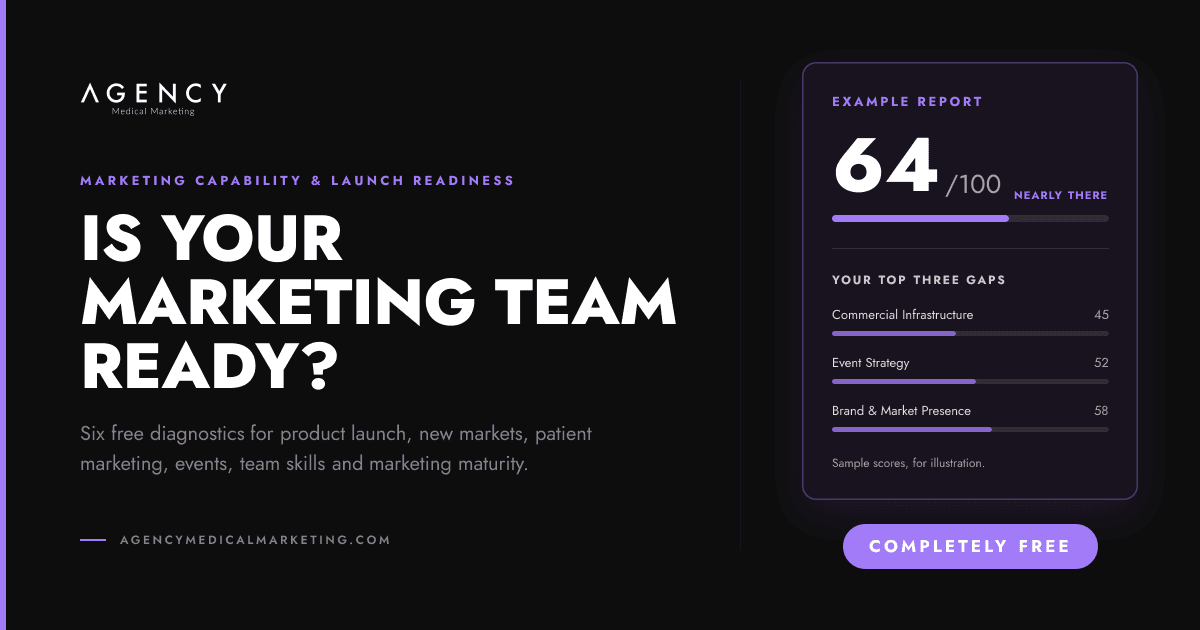
Check product launch and marketing department readiness. Get useful results and 30-day actions before an optional emailed report.
Find your marketing gaps
Work through the decisions behind a compliant healthcare campaign. See where your approach moves forward or gets stuck.
Play Snake Oil & Ladders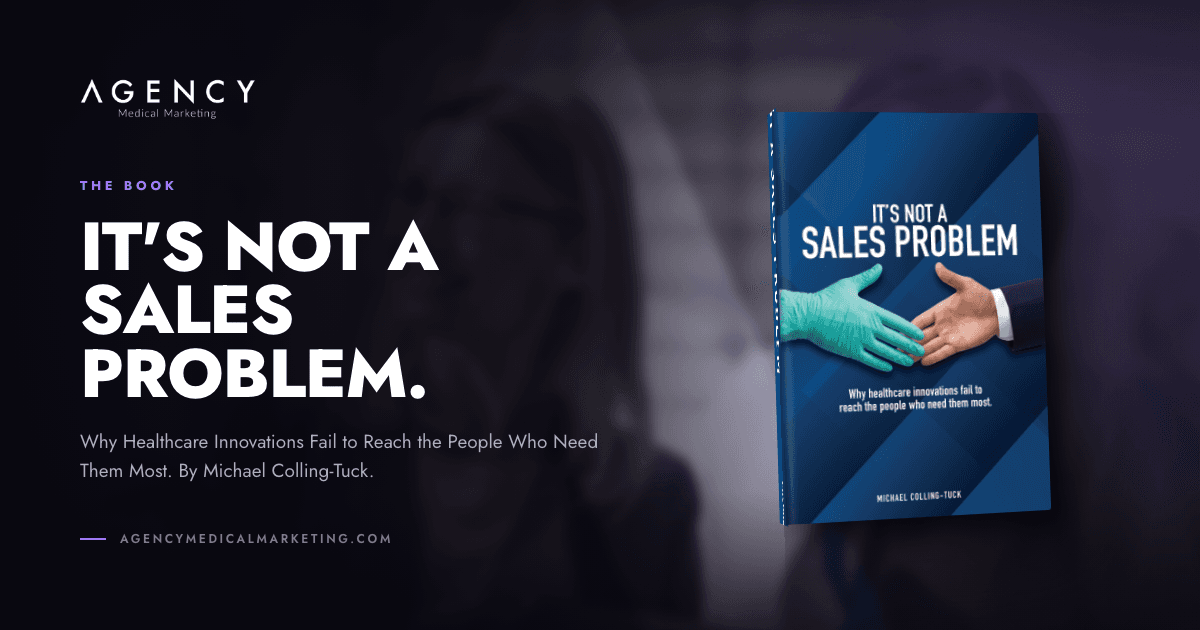
Explore why good healthcare products struggle to reach the people who need them, and how to build demand. Read three free chapters.
Read three free chapters